
Platform updates come first in this month’s release, followed by enhancements to risk and liquidity tooling – together targeting more advanced trading workflow improvements, tighter compliance controls, and more precise execution management across Match‑Trader. In combination, the changes shape a day-to-day experience that feels more intuitive, more controlled, and more consistent for traders, brokers, and internal teams alike. Key updates include:
- Price Alerts System – track instrument price moves and get notified when defined thresholds are reached
- Trading Actions During Closed Sessions – submit pending orders and adjust TP/SL levels even when the market session is not active
- Guided Onboarding for Geolocked Countries – capture residency and citizenship declarations during signup to support jurisdiction-driven access controls
- Indicator Templates – apply standardized indicator logic without replacing the entire chart layout
- Phase Configuration and First Withdrawal Condition – let admins govern first-withdrawal eligibility across funded-account phases
- Streamed Historical Data in MTR Manager – start reviewing Orders, Ledgers, and Closed Trades immediately while remaining data continues loading
- Date and Time Range Filtering in MTR Manager – filter by exact date and time on any time column to support investigations, reporting, and audits
- VWAP Slippage in Orders Summary – add a volume‑weighted slippage metric to Orders Summary that stays aligned with active filters
- Consistent Outcomes Regardless of Swap Direction – ensure swap markup behavior remains predictable for both brokers and traders
- Long-Only/Short-Only Targeting – introduce direction-aware routing rules for more controlled execution and liquidity distribution
- Mirroring Options and Reverse Mirroring Safeguards – enable automated hedge replication while adding protections that support system stability
Price Alerts System
With this release, staying on top of the market no longer requires traders to keep charts open continuously. The Price Alerts feature introduces instrument-wide monitoring based on explicit conditions. A user sets a price threshold, selects whether the alert should trigger when price crosses above or below that level, and chooses the notification channel – mobile push notifications or in-app toast notifications.
Alerts are managed in a dedicated view that lists active alerts and maintains a complete history, recording what triggered each alert, the trigger time, and the precise trigger price. That history gives traders the context needed to refine thresholds over time using real market behavior. Alerts operate across desktop and mobile: once configured, notifications reach the trader on all devices, regardless of where the alert was created.
Benefits:
- Fewer missed opportunities: Always-on monitoring replaces constant chart watching, helping traders catch relevant price moves and respond in time.
- Stronger platform competitiveness: An intelligent alerting layer increases engagement and platform traffic, while giving brokers tools that support long-term retention.
- Faster query resolution: Alert history acts as an audit trail, letting support teams resolve trigger-related questions accurately without relying on trader recollection.
Trading Actions During Closed Sessions
Market timing doesn’t always match session hours, so the workflow shouldn’t stop when sessions close. Traders can now place pending orders and edit Take Profit / Stop Loss on existing positions outside active market sessions, including weekends and after-session periods.
Pending orders are queued for execution at the next session open, while risk controls remain editable throughout – traders can add, adjust, or remove TP/SL levels without needing live market access.
Benefits:
- Fully prepared strategies: Off-hours preparation becomes part of the standard workflow, so traders can enter each session with setups already built.
- Uninterrupted risk control: TP/SL can be managed continuously, preventing situations where positions remain exposed overnight due to session closure.
- A bridged competitive gap: Meeting the expectation of off-hours order preparation equips brokers with the capability that serious traders increasingly consider a baseline.
Guided Onboarding for Geolocked Countries
Registrations originating from geolocked locations now follow a guided questionnaire that captures residency and citizenship declarations at the appropriate point in onboarding. If the signup originates from a restricted jurisdiction, trading can be blocked accordingly. All submitted declarations are also surfaced in CRM and Platform Config, enabling the relevant team to verify eligibility more efficiently.
Benefits:
- A repeatable, auditable eligibility workflow: Jurisdiction-based compliance is handled consistently through a structured, documented process that scales without extra operational load.
- Faster, more confident reviews: Centralized declarations inside internal tools reduce manual follow-ups, turning verification into a more streamlined process.
Indicator Templates
For traders who depend on a fixed indicator stack, consistency across charts is critical. Indicator Templates let users save any chosen set of indicators along with each indicator’s configuration, then apply that package to any chart in a single click. Templates are stored separately from Chart Templates, specifically for traders who want standardized indicator logic without overwriting the entire chart layout.
Benefits:
- Consistent multi-indicator setups: Removes repetitive manual configuration and reduces the risk of setup errors by applying the full indicator logic in one action.
- Separation of indicator logic and chart visuals: Advanced users can manage analysis settings independently from chart appearance and layout.
Phase Configuration and First Withdrawal Condition
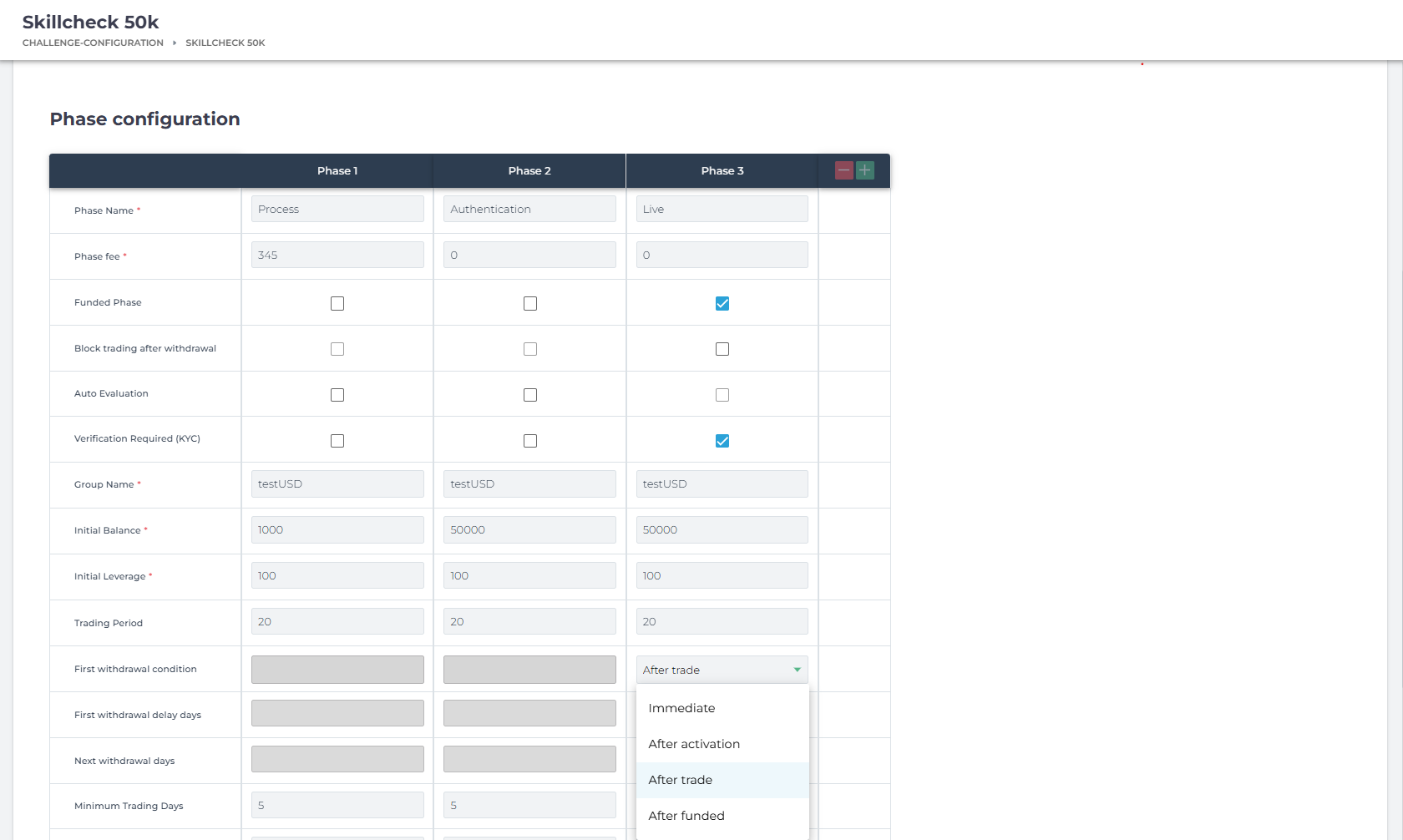
Funded-account phase configuration now includes a First Withdrawal Condition, enabling administrators to define when the first withdrawal becomes available. Supported options include: immediate access, access after funded activation, access after the first trade, or access after a configurable delay within the funded phase – forming a structured, rules-based payout framework.
Benefits:
- Full control over payouts: Withdrawal policy can be enforced consistently across accounts and phases, supporting disciplined risk management.
- Transparent withdrawal eligibility: Clear criteria help traders understand exactly when withdrawals become available, reducing uncertainty and support queries.
- Standardized withdrawal rule enforcement: Operations teams avoid case-by-case manual review because rules apply uniformly and predictably across all accounts and phases.
Streamed Historical Data in MTR Manager
Historical data in MTR Manager now loads via incremental streaming, replacing the former all-or-nothing approach with batched delivery from the report service. Instead of waiting for the full dataset before anything appears, brokers see results rendered as soon as each batch arrives from the underlying store.
This change allows Orders, Ledgers, and Closed Trades to be reviewed immediately while the remaining results continue loading in the background. A visible loading indicator stays on-screen until completion, keeping progress clear without interrupting work. The update applies to both general and detailed views across all three tabs, removing the long blank waiting periods that previously followed heavier filter queries.
Benefits:
- Near-immediate access to trading history: Brokers can begin reviewing key records within seconds, turning prior wait time into analysis time.
- Faster operational investigations: Dealing desks and operations teams can review closed trades, validate ledger movements, and complete end-of-day checks with shorter turnaround.
- Smoother performance on large queries: Larger historical requests no longer break workflow continuity, making broader filters practical to use.
Date and Time Range Filtering in MTR Manager
Every time-based column in MTR Manager now supports precise date-and-time filtering, giving brokers stronger control over how operational data is searched and analyzed. Instead of being limited to calendar-day filters, users can narrow down to a specific hour or minute, improving both investigation accuracy and reporting precision.
New “from” and “to” inputs accept full timestamps and default to full history when left empty, preserving flexibility for both broad reviews and highly targeted queries. The same control appears consistently across each Manager tab that includes a time column, creating a unified filtering experience throughout the application.
Benefits:
- Minute-level investigation accuracy: Operations teams can isolate exact incident windows faster, accelerating routing, execution, and post-event analysis.
- Stronger intraday reporting control: Dealing desks gain the granularity needed to compare activity across specific windows, sessions, or operational periods.
- More focused compliance reviews: Audits can target precise hours under review instead of requiring broad full-day extracts.
VWAP Slippage in Orders Summary
MTR Manager’s Orders Summary table now shows VWAP Slippage as its own column, available in both the overall Orders view and the per-account Orders view. The result is a more informative, volume-adjusted view of execution quality for whatever set of orders is currently selected.
The value is derived by taking the volume-weighted mean of slippage for the orders shown, mirroring the slippage concept already used at the row level. Any order that has no slippage value (because a base price is missing) is left out of the calculation entirely, so the final number represents only valid execution data. If filtering leaves nothing eligible to compute, the summary shows “—” rather than 0, preventing misleading interpretation.
Benefits:
- Clearer execution-quality insight: Dealing desks can assess slippage quality instantly using a volume-weighted metric, making performance reviews faster and more meaningful.
- Stronger account-level comparison: The same VWAP Slippage approach appears in account summaries, enabling consistent like-for-like comparisons between accounts.
- Real-time analytical alignment: The metric responds immediately to filtering, updating as the Orders view is narrowed or expanded.
Consistent Outcomes Regardless of Swap Direction
Swap markup logic has been rebuilt so results remain deterministic and direction-consistent. A positive markup consistently benefits the broker, and a negative markup consistently benefits the trader – even if the underlying swap amount changes from positive to negative (or the other way around). This removes prior edge cases that could cause instrument-level unpredictability.
Benefits:
- More reliable profitability behavior: Brokers can rely on positive swap markups producing the intended revenue effect without unexpected sign flips.
- Trustworthy pricing: Traders get consistent, predictable outcomes for negative markups, reinforcing confidence in the platform’s pricing integrity.
- Reduced operational and financial risk: Ambiguous swap-configuration outcomes are removed, cutting a meaningful source of edge-case exposure in daily operations.
Long-Only/Short-Only Targeting
Routing rules can now be set up with trade-direction conditions. Each rule may apply to long-only, short-only, or both, enabling tighter control over execution behavior and liquidity distribution strategies.
Benefits:
- Tighter, policy-aligned execution control: Direction-based routing helps dealing and risk teams ensure all trades follow internal policy and LP agreement constraints.
- Sophisticated flow segmentation: Brokers can segment flow more precisely, improving how volume is allocated and sent to liquidity providers.
Mirroring Options and Reverse Mirroring Safeguards
Hedging configuration now supports position mirroring onto a designated account. Settings allow administrators to turn mirroring on, provide the mirror account ID, and control reverse-mirroring behavior in a way designed to avoid configuration loops.
Benefits:
- Automated hedge replication: Risk teams can maintain continuous hedge coverage with consistently mirrored positions, reducing manual workload and common replication mistakes.
- Safer configuration patterns: Built-in safeguards let administrators roll out complex mirroring setups without self-referential loops or unintended system stability issues.